https://arxiv.org/abs/2512.07806
Multi-view Pyramid Transformer: Look Coarser to See Broader
We propose Multi-view Pyramid Transformer (MVP), a scalable multi-view transformer architecture that directly reconstructs large 3D scenes from tens to hundreds of images in a single forward pass. Drawing on the idea of ``looking broader to see the whole,
arxiv.org
Related Work
Multi-view transformer 계열의 흐름
- 최근 3D reconstruction은 전통적인 geometry-based pipeline만 쓰기보다, transformer가 여러 view의 image token을 직접 보고 3D 구조를 추론하는 방향
- DUSt3R 이후 multi-view transformer가 중요한 흐름이 되었고
- multi view transformer에 세 가지 계열 在
- 3D geometry reconstruction
- multi-view image로부터 camera pose, point map, depth 등을 feed-forward하게 예측
- large view synthesis models
- novel view synthesis, 즉 보지 않은 시점의 이미지를 photorealistic하게 생성하는 데 집중
- large reconstruction models
- explicit/implicit 3D representation을 사용해 large-scale scene reconstruction과 novel view synthesis를 동시에 수행
- 3D geometry reconstruction
- 어쨌든 이 세 방법의 공통점 → multi-view attention 사용
- multi-view attention은 여러 view 사이의 correspondence를 찾는 데 유리
- 3D reconstruction에서는 “이 이미지의 이 patch가 다른 view에서는 어디에 대응되는가?”를 알아야 하므로 correspondence reasoning이 중요
- However, multi view attention의 문제점:
- attention cost가 너무 큼
- 이미지 한 장은 많은 patch token으로
- view 수가 늘어나면 전체 token 수가 급격히 증가합니다.
- self-attention은 token 수에 대해 quadratic complexity를 가지므로, 고해상도 이미지 + 많은 view 조합에서 계산량, 메모리 미침
- 기존 scalable model들도 한계가 있음
- Long-LRM
- Transformer와 bidirectional Mamba를 결합
- Mamba의 linear-complexity 덕분에 효율성은 개선
- 하지만 저자들은 Mamba가 self-attention보다 expressive capacity가 제한될 수 있다고 봄
- iLRM
- compact scene representation을 사용
- 모든 input view에 대해 full attention 가능
- But, view 수가 늘어나면 global attention 자체가 bottleneck이 됨
- LVT
- local-view attention을 사용
- 각 view가 nearby view만 attend함
- 계산량은 줄지만 global 3D consistency가 간접적으로만 형성됨
- view 간 neighborhood를 어떻게 정의할지도 어렵고, known camera pose 의존성도 생김
- Long-LRM
- full global attention도 long-context에서 안정적이지 않음
- full global attention은 이론적으로 모든 view/token 간 interaction이 가능
- 하지만 view 수가 많아지면 attention이 너무 넓게 퍼짐 → correspondence learning이 불안정해질 수 O (attention dilution 문제)
- 결과적으로 view 수를 늘려도 성능 향상이 둔화되거나, 오히려 feature alignment가 불안정해질 수 있음
- attention cost가 너무 큼
Efficient sequence model 흐름
- 긴 sequence를 처리하기 위한 기존 방법은 보통 두 방향
- Attention mechanism 자체를 바꾸는 것: sparse attention, local window attention, linear attention
- Token representation을 줄이는 것 : token compression, token merging, downsampling
- 물론 efficient~ 방법에도 한계 O
- 기존 hierarchy는 주로 image 내부 spatial domain에만 적용
- 즉, 이미지 token resolution은 줄일 수 있지만, multi-view setting에서 view dimension까지 계층적으로 처리하지는 못함.
- ⇒ spatial hierarchy와 view hierarchy를 동시에 설계해야 함
Methods
Overview
- MVP: Multi-view Pyramid Transformer
- 핵심 아이디어: Look coarser to see broader
- 처음에는 coarse하게(frame/high) → 적당히(group/mid) → 넓게(global/low)
Architecture
Input multi-view images
→ camera-aware input encoding
→ 3-stage Dual Attention Hierarchy
→ Pyramidal Feature Aggregation
→ dense prediction head
→ 3D Gaussian Splatting reconstruction
- Input encoding
- 입력: N개의 multi-view image
- 각 image에 대해 camera pose 정보를 함께 넣음
- 이때 camera pose는 9D Plücker ray map으로 encoding됨
- RGB image와 Plücker ray map을 concat → 12-channel posed-image tensor 만듦
- 이후 patchify해서 transformer token으로 변환
- 각 view마다 register token 추가
- 입력: N개의 multi-view image
- Dual attention hierarchy
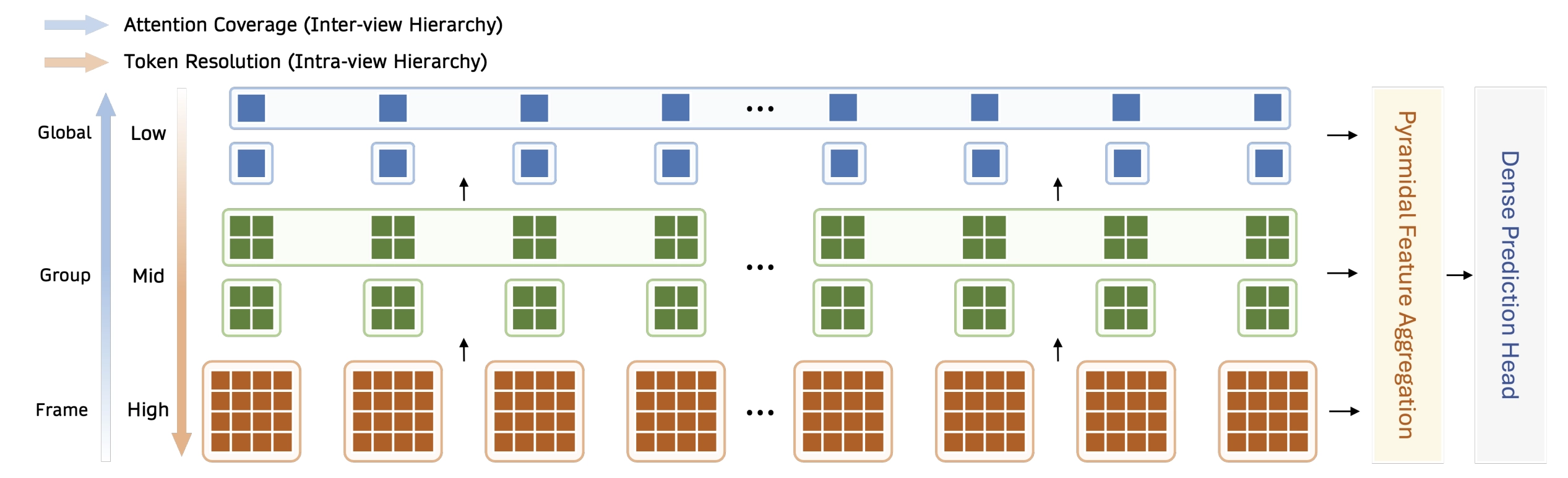
-
- 두 개의 hierarchy가 동시에 작동
- Inter-view hierarchy
- view 사이 attention 범위를 점점 넓힘 (frame to global, 파란 방향)
- Intra-view hierarchy
- image 내부 token resolution을 점점 낮춤 (global to frame, 주황 방향)
- Inter-view hierarchy
- 두 개의 hierarchy가 동시에 작동
- Inter-view Attention Hierarchy: frame → global
- view 간 correspondence와 global 3D consistency를 효율적으로 학습하는 구조
- Stage 1: Frame-wise attention
- 각 frame/view 내부에서만 self-attention을 수행
- view 간 interaction은 아직 X
- 각 image의 local spatial feature와 fine geometry cue를 추출
- 각 frame/view 내부에서만 self-attention을 수행
- Stage 2: Group-wise attention
- 여러 view를 작은 group으로 나누고
- 먼저 frame-wise attention → 그 다음 group 내부에서 self-attention
- 이 단계에서 local multi-view correspondence를 학습 (즉 가까운 view들끼리 정보 교환)
- Stage 3: Global attention
- 모든 view를 하나의 group처럼 보고 attention
- scene 전체의 global context를 통합
- 최종적으로 coherent한 3D representation을 형성
- Intra-view Attention Hierarchy: global → frame
- image 내부 spatial token을 점점 coarse하게 만듦 → 계산량을 줄이고 receptive field를 키우는 구조
- How?
- stage 사이에 convolution layer 두고
- 이 conv layer가
- spatial downsampling
- channel up-projection
- 즉, token 하나가 더 넓은 spatial region을 대표하게 되는 것
- → 각 stage마다 image token 수가 1/4로 줄어들고 embdding dim. 증가함 (당연하지 conv downsampling 했으니까)
- 그리고 Inter-view와 Intra-view를 합침
- 즉 view coverage는 점점 넓어지고 + spatial token resolution은 점점 낮아짐
- 이러면 Pros?
- 초반에는 token 수가 많기 때문에 global attention이 expensive
- 그래서 frame-wise/local하게 처리합니다.
- 후반에는 token 수가 줄어들었기 때문에 더 많은 view를 attend할 수 있음
- local detail 유지
- global consistency 확보
- computation/memory 절약 可
- 이때 Pyramidal Feature Aggregation(PFA)로 합치는데
- 마지막 stage의 coarse feature만 사용하면 fine detail이 부족할 수 있고
- dense prediction에서는 local detail도 중요하기 때문임
- PFA는 Stage 1, 2, 3의 feature를 모두 모으고
- coarse feature를 upsample하면서 이전 stage의 finer feature와 fuse
- residual convolutional fusion block을 사용
- F1, 2, 3은 reshaped output feature maps from each stage.
- Inter-view hierarchy: frame-wise → group-wise → global local view → broader view Intra-view hierarchy: fine token → coarse token high resolution → low resolution
- Output Decoding
- PFA로 합쳐진 token을 dense prediction head에 넣음
- 각 output pixel은 하나의 3D Gaussian primitive를 예측
- 각 Gaussian은
- position
- scale
- rotation
- opacity
- color
- MVP transformer가 multi-view image를 처리하고
- 그 결과를 3DGS representation으로 변환
- 이후 3D Gaussian Splatting 방식으로 novel view를 rendering
'논문 리뷰' 카테고리의 다른 글
| [논문 리뷰] NeRF: Representing Scenes as Neural Radiance Fields for View Synthesis (0) | 2026.01.19 |
|---|
